

If you’re operating an e-commerce business in 2026, you’ve likely already experienced it – what was true two years ago is now stale. The bar for customers is higher, the competition is fiercer, and the tolerance for frustration is lower than ever. A slow-loading page, a confusing checkout process, or a generic product page can quietly sabotage conversions.
This is precisely why e-commerce statistics are so important. Not the kind of numbers that make you feel good – but hard, actionable data that shows you how consumers behave, what they want, and where businesses are losing money without even realizing it.
At Qortechno, we’ve dedicated years to developing, redeveloping, and scaling e-commerce sites for brands across India. As a reputable e-commerce development company in Bangalore, we witness firsthand how businesses that make decisions based on the right data have a clear advantage over those that make decisions based on intuition.
Let’s dissect the top 10 most crucial e-commerce statistics in 2026 – and, more importantly, what you should do about them.
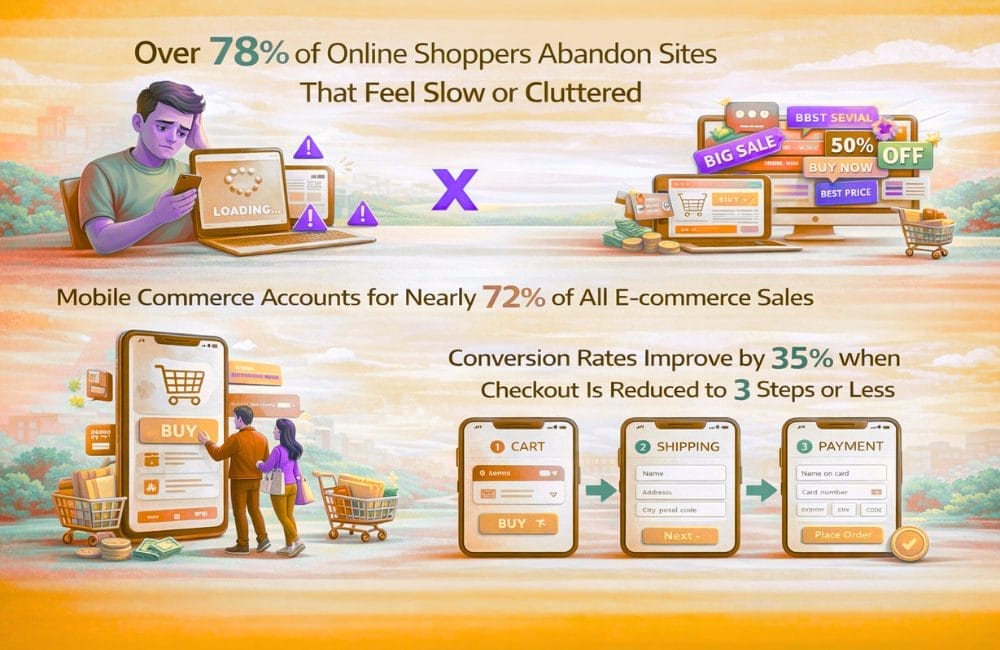
1. Over 78% of Online Shoppers Abandon Sites That Feel Slow or Cluttered
Speed and clarity are no longer “nice to have.” They’re survival essentials.
Customers expect e-commerce websites to load in under three seconds and guide them smoothly from product discovery to checkout. Bloated layouts, heavy scripts, and outdated e-commerce website design cost real revenue.
What this means for your business:
Your e-commerce web development must prioritize performance, clean UX, and lightweight design.
What to do next:
Invest in custom e-commerce website development focused on speed optimization, simplified navigation, and performance testing — not pre-made themes stretched beyond limits.
2. Mobile Commerce Accounts for Nearly 72% of All E-commerce Sales
Desktop-first thinking is officially dead.
In India, especially, mobile devices dominate online shopping — from browsing to payment. If your e-commerce website design still “adapts” to mobile instead of being designed for mobile, you’re already behind.
Why it matters:
Mobile users bounce faster and convert less if the experience feels cramped or confusing.
Smart move:
Work with an e-commerce web design company that builds mobile-first e-commerce website design services, not desktop sites resized for phones.
3. Conversion Rates Improve by 35% When Checkout Is Reduced to 3 Steps or Less
Every extra field is a reason to leave.
Lengthy registration forms, forced sign-ups, and unclear payment flows are among the biggest conversion killers we see in audits.
Implication:
Your e-commerce development services must focus on checkout UX, not just product pages.
What brands should do:
Simplify checkout logic during e-commerce web development, enable guest checkout, and remove unnecessary steps.
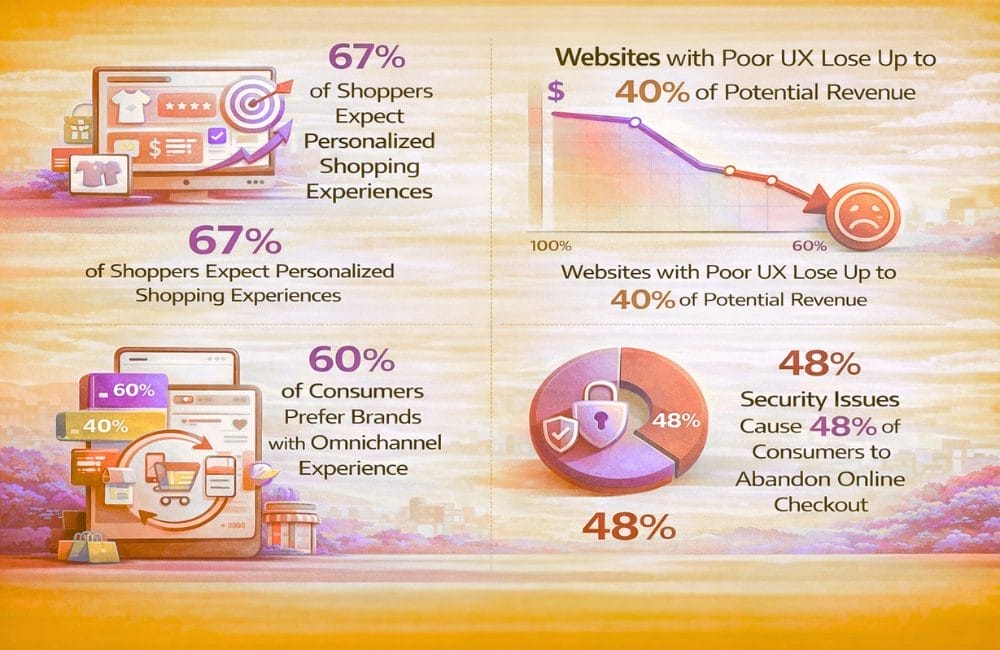
4. 67% of Shoppers Expect Personalized Shopping Experiences
Generic storefronts don’t build loyalty anymore.
Shoppers expect relevant products, smart recommendations, and content that feels tailored — especially in competitive categories like fashion, electronics, and D2C brands.
Why this matters:
Personalization directly impacts repeat purchases and average order value.
Next step:
Choose an e-commerce development agency that builds scalable, customizable e-commerce website development — not rigid platforms that limit personalization.
5. Websites with Poor UX Lose Up to 40% of Potential Revenue
This stat hurts — but it’s real.
We’ve seen visually “beautiful” e-commerce sites fail because users couldn’t find products, filters were confusing, or CTAs weren’t clear.
Key takeaway:
Design for e-commerce website success is about usability, not aesthetics alone.
Action point:
Partner with an e-commerce website design company that blends UX strategy with real buyer behavior insights.
6. 60% of Consumers Prefer Brands with Omnichannel Experience
Customers don’t think in terms of channels. They look for information on mobile, compare on desktop, and buy on social media or marketplaces.
Unintegrated systems will only irritate customers and damage the brand’s trust.
What it means:
Your e-commerce web development company should build platforms that integrate perfectly with CRM, inventory, and marketing software.
What to do:
Choose e-commerce development services that emphasize omnichannel growth, not just website launches.
7. Security Issues Cause 48% of Consumers to Abandon Online Checkout
Trust is a fragile thing for e-commerce companies.
The absence of SSL certificates, outdated payment systems, and confusing policies will raise red flags instantly.
Why it matters:
Security is not a backend problem—it occurs in real-time and impacts conversions.
Best practice:
Choose an e-commerce development Company India that follows secure development best practices and security compliance guidelines from the very beginning.
8. Custom-Built E-commerce Platforms Outperform Template Sites by 32%
Templates are fast. Custom is profitable.
Off-the-shelf themes often limit scalability, performance, and brand differentiation — especially as your business grows.
What this tells us:
Serious brands eventually outgrow templates.
Next step:
Invest in custom e-commerce development that aligns with your business model, customer journey, and long-term goals.
9. Brands That Optimize UX See 2x Higher Customer Retention
Acquisition is expensive. Retention is profitable.
Simple improvements in e-commerce site design — faster navigation, clearer product pages, smarter search — keep customers coming back.
Why this matters:
Retention compounds revenue over time.
Solution:
Choose an e-commerce web design agency that treats UX as a growth lever, not a visual exercise.
10. High-Performing E-commerce Brands Update Their Platforms Every 12–18 Months
e-commerce is not “build once and forget.”
Platforms, customer expectations, and technologies evolve fast.
Implication:
Your e-commerce website development services should support continuous improvement.
Smart approach:
Partner with an e-commerce website development agency that offers long-term scalability and optimization — not just project delivery.
What These E-commerce Statistics Mean for Indian Businesses
India’s e-commerce market is growing rapidly, but competition is brutal. Cities like Bangalore have become major e-commerce and technology hubs, with brands launching every week.
For Indian businesses, these statistics highlight one truth:
👉 Your e-commerce website is your most critical business asset.
Working with an experienced e-commerce development company in Bangalore gives you access to technical expertise, UX strategy, and local market understanding — all essential for sustainable growth.
How Qortechno Can Help
At Qortechno, we don’t just build e-commerce websites. We build platforms that are designed to convert, scale, and grow.
As a trustworthy e-commerce website development company, we help with:
- Custom e-commerce website development based on your business model
- UX-focused e-commerce website design services that convert
- Scalable e-commerce web development services that are designed for growth
- Performance-optimized e-commerce site design for speed and usability
- Full-service e-commerce development services from conceptualization to launch
Our approach is straightforward: understand your customers, design for real behavior, and build platforms that enable growth – not just design.
Conclusion:
Build for Where E-commerce Is Going, Not Where It’s Been
The e-commerce brands that will thrive in 2026 won’t be the boldest. They’ll be the brightest – armed with data insights, user behavior knowledge, and experience-driven design expertise.
These e-commerce numbers aren’t just numbers. They’re signposts that point to where you should be investing, what you should be improving, and how you can future-proof your e-commerce business.
If you’re ready to scale, it’s time to rethink your e-commerce platform and work with a company that knows technology and business.
📌 Let’s discuss with Qortechno, the best e-commerce development company in Bangalore, and build an e-commerce platform that’s ready for what’s next.
FAQ
E-commerce statistics give a glimpse into how real users actually behave – where they drop off, how trust is built, and what works. In 2026, making the wrong decisions based on assumptions about how users behave instead of making decisions based on facts will mean slow-loading sites, poor UX, and lost opportunities. Businesses that make decisions based on facts about performance, mobile, UX, and personalization will continue to outperform those making decisions based on assumptions.
Website speed is directly associated with trust and revenue. More than 78% of users tend to abandon a website that is slow or cluttered. One second of delay can be a loss of revenue that is catastrophic in nature. Successful e-commerce websites focus on simple designs, optimized code, and fast checkout processes during e-commerce website development.
More than ever. Almost 72% of e-commerce transactions are happening on mobile, and this is most apparent in India. Mobile-first e-commerce website design is the need of the hour for faster loading, easy navigation, and a smooth checkout process, which is the need of the hour for lowering bounce rates and increasing mobile conversions.
Custom e-commerce websites are more effective than template-based e-commerce websites because custom e-commerce websites are designed with the goal of speed, scalability, user experience, and personalization in mind. Templates are always very performance-restrictive, whereas custom e-commerce development allows brands to develop around their customer journey, business model, and strategies.
The influence of UX optimization is observed in the areas of navigation, trust, and purchase. Brands that concentrate on UX-driven e-commerce website design can retain up to twice as many customers.
A successful e-commerce business updates and optimizes its site every 12 to 18 months.
